
Magic Piano: Rhythm Challenge
JMGameMusic
4.325.00 Reviews
- Version
- 4.1.6
- Installs
- 10.00M
- Age Rating
- Everyone
Screenshots
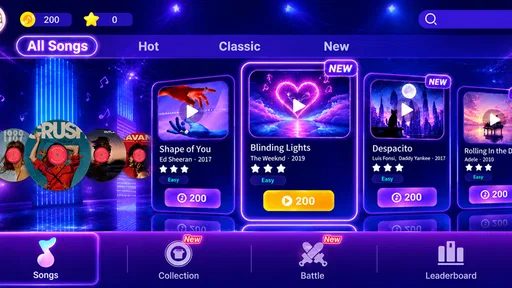
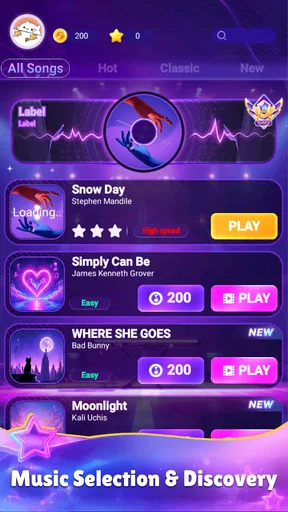
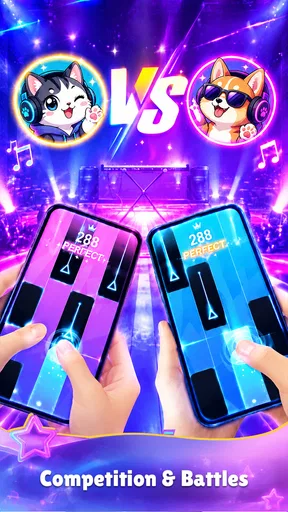
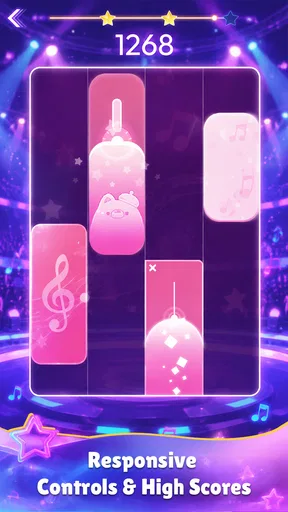
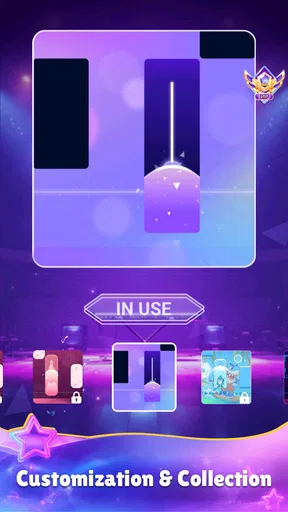

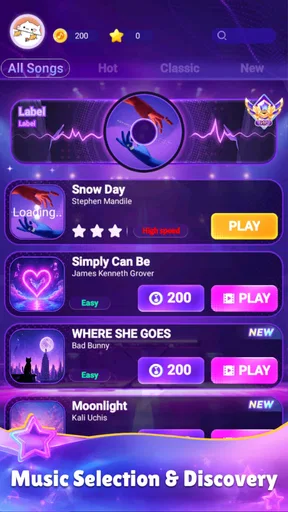
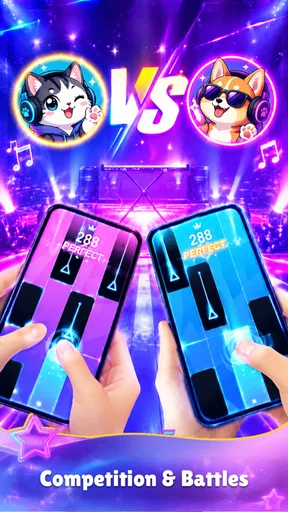
Our Review of Magic Piano: Rhythm Challenge
 Analysis by Appyee
Magic Piano: Rhythm Challenge is the kind of music game I can open for a quick break and understand immediately: notes arrive, I tap along, and the song becomes a test of timing rather than a passive listening experience. That simplicity is its strongest first impression. Developed by JMGame, this free game sits in the music category and is suitable for Everyone, so it is easy to recommend to someone who wants a light reflex challenge without learning a complicated ruleset.
After spending time with it, I found that the real appeal is not simply tapping quickly. The game asks me to read the screen, anticipate what is coming, and stay calm when the rhythm becomes less forgiving. That creates a small but satisfying loop: choose a song, try to keep control, notice where I slipped, and immediately want another attempt. Its best quality is how quickly it turns a familiar musical idea into an active concentration exercise.
How the goals and progression feel during play
I find the most useful way to judge progress here is to look for steadier decisions, not just faster tapping: notice whether you can recover after a missed note without letting it throw off the rest of the song. That makes each attempt feel like a small, manageable goal rather than a pass-or-fail test. It also leads to a practical question for shared devices: how do different players take turns without making the game feel like a competition?
The first goals are clear, even when the game stays simple
The opening experience is easy to grasp because the central objective is visible from the first session. I am not sorting through a complicated character build or trying to understand several currencies before playing. I simply focus on the notes and try to complete the song cleanly. That directness matters on a phone, especially when I want something that works in short bursts.
The early goal is therefore personal rather than strategic: improve my timing, finish more confidently, and avoid repeating the same mistake. A missed note is immediately understandable. I do not need a tutorial full of explanations to know what went wrong; my attention drifted, my finger arrived late, or I reacted to the wrong visual cue. That makes each retry feel purposeful instead of random.
I also like that the game’s music theme gives those early attempts more character than a completely abstract reflex test. The notes are connected to the song, so progress is felt through rhythm as well as completion. Even when I am not chasing a perfect result, I can hear and feel whether my tapping is becoming more controlled.
That said, players looking for a deep rhythm-training tool should set their expectations correctly. This is an accessible mobile game, not a replacement for learning an instrument or practicing music theory. The goal is to respond accurately inside the game’s pattern, and that is enjoyable in its own right, but it should not be confused with developing broader musical technique.
Progress is easiest to notice through performance
One of the more interesting aspects of the progression is that improvement is not only about reaching a new point on a menu. I notice it in the way a previously uncomfortable section becomes manageable. At first, I may watch every note with tension. After a few attempts, I start recognizing the movement earlier and tapping with less hesitation. That change gives the game a useful sense of momentum even when the basic interaction remains unchanged.
The game’s public reception also suggests that this straightforward loop has found a sizeable audience. It holds an average rating of 4.3 from around 32 thousand ratings, and it has passed 10 million installs. Those figures do not guarantee that every player will enjoy the same songs or difficulty, but they do make the game feel like an established choice rather than an obscure experiment.
For me, the most useful way to approach progress is to treat each attempt as a short practice session. Instead of tapping faster whenever a section becomes difficult, I try to identify the exact moment where my attention breaks. Sometimes the problem is not speed at all; it is looking too far ahead, reacting to a visual change, or losing the beat after one mistake. That distinction helps me improve without turning every failure into frustration.
A practical routine is to play one familiar song first, then try a more demanding one while my hands and attention are settled. Returning to the familiar track afterward gives me a clear comparison point. I can tell whether I am genuinely more consistent or merely rushing because I want to finish. This kind of self-check is more valuable here than chasing an abstract idea of being fast.
The difficulty curve rewards attention, not just quick fingers
The challenge works best when I stop treating it as a pure speed contest. Fast reactions help, but rhythm games punish panic. If I tap early because I expect the next note, I can create a chain of errors that would not have happened if I had kept watching the pattern. The difficulty therefore comes from combining anticipation with restraint.
That makes the game approachable for casual players while still leaving room for mastery. Someone can enjoy the music and basic tapping without needing exceptional reflexes, while a more competitive player can focus on cleaner runs and tighter timing. The same song can feel relaxed one moment and demanding the next, depending on concentration, fatigue, and how seriously I am trying to perform.
The curve is not perfect for everyone. Players who prefer a clearly explained ladder of goals, carefully labeled stages, or a strongly narrated progression may find the experience less motivating than a traditional level-based game. Magic Piano: Rhythm Challenge is more immediate than elaborate. Its challenge comes from execution, and that means the sense of advancement depends heavily on whether I personally enjoy repeating songs to improve.
I found that headphones can make the experience more comfortable, particularly when the surrounding environment is noisy. They are not a substitute for paying attention to the screen, but clearer audio can help me stay connected to the beat. In a quiet room, the game is also easy to use without turning it into a major event, which suits its short-session design.
Where the pacing keeps me playing
The pacing succeeds because a failed attempt does not require a long recovery. I can understand the mistake, reset mentally, and try again while the pattern is still fresh in my memory. That short distance between failure and retry is important. It prevents the game from feeling like a chore when I am only playing for a few minutes.
A realistic use case is a commute or a waiting room. I can play one song while waiting, stop without losing an entire evening, and return later when I have more attention available. It also works as a small break between heavier tasks: the game asks enough from me to interrupt work-related thoughts, but not so much that I need a long explanation before starting.
There is a trade-off here. The same quick loop that makes the game convenient can make it feel repetitive if I want broader variety in goals. I may enjoy improving a difficult section for a while, but eventually I need either a new musical challenge or a personal reason to keep replaying. This is where the game’s retention depends on my relationship with rhythm and repetition rather than on a complex progression structure.
In-app purchases range from $0.99 to $9.99 per item. Since the game itself is free, I would begin without spending anything and first decide whether the song selection, pacing, and difficulty hold my attention. That is the sensible approach for this type of title: play enough to understand the core loop, then consider optional purchases only if they add value to the way I actually play.
Retention pressure is present, but it should not control the session
Every retry can create a mild pressure to prove that the next attempt will be better. I recognize that feeling from other reflex games: one mistake near the end makes me want to immediately go again, even when my concentration is already fading. That can be motivating, but it can also turn a short break into a string of increasingly careless attempts.
My advice is to use a stopping rule. If I miss the same section several times because I am tired rather than learning, I stop and return later. This sounds simple, but it changes the experience considerably. The game is more enjoyable when I treat progress as gradual improvement instead of demanding a perfect run every time I open it.
The music category gives the game an advantage over many generic reaction tests because the rhythm provides a natural reason to continue. I am not only trying to beat a timer; I am trying to stay with a song. That connection can make repetition feel less mechanical. Still, players who dislike replaying the same material should know that the core satisfaction comes from refining performance, not from constantly discovering a new type of activity.
For younger players, the Everyone rating makes the game approachable, but I would still encourage sensible play habits. A title can be age-appropriate and remain absorbing, especially when each failed attempt feels close to success. Short sessions and breaks are a better fit than leaving it running indefinitely.
Who will enjoy it most, and who should choose something else
I would recommend Magic Piano: Rhythm Challenge to casual players who like music, quick reflex tests, and games that explain themselves through interaction. It is also a good fit for someone who wants a low-commitment title that can be played in short sessions. If you enjoy improving a run by watching your timing become steadier, the simple structure works in its favor.
I would be more cautious about recommending it to players who want a full musical sandbox, instrument practice, or a deep competitive ecosystem. Someone seeking detailed composition tools should choose a music-making app instead. Someone who wants a story, role-playing progression, or a large strategic layer will probably find the tapping loop too narrow. Likewise, if repeated attempts feel boring to you, the game may lose its appeal before its challenge has time to develop.
Compared with a conventional rhythm game built around elaborate stages and extensive customization, this title feels lighter and more immediate. Compared with a basic reflex game with no musical identity, it offers a stronger sense of flow because the tapping is tied to songs. That middle position is its clearest advantage: it is more engaging than a bare reaction test, but less demanding and less expansive than a serious rhythm-focused alternative.
Device expectations and practical decisions
The game supports Android 7.0 and later, which makes it accessible on a broad range of compatible devices. I would still pay attention to the physical experience rather than only the operating-system requirement. A clean screen, responsive touch input, and a comfortable grip matter more here than advanced graphical power. If the phone is crowded with notifications or the display is difficult to read, accurate tapping becomes harder for reasons unrelated to the game itself.
The current version is 4.1.6, and the title is available at no upfront cost. That combination makes trying it straightforward. I would install it when I want a quick music game, play several sessions without assuming that popularity guarantees a personal fit, and then decide whether the available challenge is enough for me.
One small but useful habit is to avoid playing immediately after a frustrating attempt in another game. Rhythm accuracy depends on a calm visual rhythm, and carrying irritation into the next song makes me tap reactively. I get better results when I give myself a few seconds to settle, especially before attempting a section that previously caused trouble.
My progression verdict
Magic Piano: Rhythm Challenge sustains play through a clean sequence of goals: understand the tapping, finish songs, improve timing, and return to difficult passages with more control. Its progression is not built around a complicated web of systems, and that is both its identity and its limitation. The game stays approachable because it keeps the focus on rhythm, but players who need constant unlocks or a more elaborate reward structure may eventually want more.
I appreciate that the challenge can be meaningful without pretending to be deeper than it is. The strongest moments come when I turn a messy attempt into a controlled one, not when I simply rush toward the next screen. The weakest moments arrive when repetition stops feeling like practice and starts feeling like obligation. Recognizing that boundary is important if I want the game to remain relaxing.
My final view is positive, with a clear condition: choose it for accessible musical tapping and short, repeatable challenges, not for a full-scale rhythm career or an instrument-learning course. If you want a free music game that gets you playing within seconds and gives your reflexes room to improve, I think it is worth trying. Just keep the sessions purposeful, judge the experience before considering in-app purchases, and move on to a more feature-heavy alternative if personal improvement alone is not enough to keep you engaged.
Verdict
Strengths of Magic Piano: Rhythm Challenge
- Large song library with tracks across pop, classical, and game music.
- Simple tap-based controls make it easy for beginners to start playing.
- Short sessions work well for quick entertainment on mobile devices.
- Progression and challenges provide motivation to keep improving timing.
- Bright visuals and responsive effects make performances feel engaging.
Limitations of Magic Piano: Rhythm Challenge
- Some songs and features may require in-app purchases or extra unlocks.
- Fast note patterns can feel difficult on smaller phone screens.
- Gameplay depends heavily on precise timing and a stable touch response.
- Repeated tracks may become less engaging for long play sessions.
- Ads or promotional prompts can interrupt the overall experience.
Other Releases by JMGame
View All
Mini relax games-No wifi
Casual4.4
Similar Picks in This Category
View All
Tiles Hop Music & Ball Game
AMANOTES PTE. LTD.4.3

Magic Tiles 3™ - Piano Game
AMANOTES PTE. LTD.4.6

Real Piano
Bilkon3.7

Piano Game: Classic Music Song
Dream Tiles Piano Game Studio4.0

Smash Colors: Music Ball Rush
BADSNOWBALL HONGKONG LIMITED4.2

Piano Music Go-EDM Piano Games
Joy Journey Music Games4.5
Frequently Asked Questions
What is Magic Piano: Rhythm Challenge?
Magic Piano: Rhythm Challenge is a music-based mobile game in which you tap notes in time with songs to create performances and earn rewards. Its gameplay is built around rhythm, timing, and accuracy rather than traditional piano simulation. As you progress, the challenge generally becomes faster and more demanding, making it suitable for short sessions as well as players who enjoy improving their scores.
Is Magic Piano: Rhythm Challenge free to download and play?
The game can generally be downloaded for free, but free access may be supported by advertisements, optional purchases, or both. Some songs, visual items, energy, lives, or progression-related features may be limited unless you watch ads or spend money. Before downloading, check the current store listing and in-app purchase details, since pricing, available content, and monetization options can change with updates.
Does the game require an internet connection?
An internet connection may be needed for the initial download, account or service checks, advertisements, updates, and access to certain songs or online features. Some basic gameplay could work temporarily without a connection, but offline availability should not be assumed for every mode. If you plan to play while traveling, test the game in airplane mode first to see which content remains accessible.
Is Magic Piano: Rhythm Challenge suitable for children?
The simple tapping controls can make Magic Piano: Rhythm Challenge approachable for younger players, but parents should review the age rating and privacy information before installation. Advertisements, optional purchases, online connectivity, and music-related content may affect suitability. It is also wise to enable purchase restrictions on the device and supervise play if the game is being used by children.
What devices are compatible with Magic Piano: Rhythm Challenge?
Compatibility depends on the specific Android or iOS version, available storage, and the developer’s current technical requirements. The game should be installed only through the official Google Play Store or Apple App Store, where your device will be checked automatically. Keeping the operating system updated can help, although older phones may experience slower performance, longer loading times, or reduced visual quality.
Play our best games!


